Roofing websites · Examples and price · $2,500 implementation waived through Oct 21
43.0608° N / 88.4037° W
Roofing Website DesignBuilt for Storm Week
Examples first, then what a roofing site actually needs, then the price. The $2,500 implementation is waived for plans started by October 21, 2026, built during the 14-day trial, then $97 a month.
TLDR
- Roofing traffic comes in waves: the week after a hail storm, the month after a wind event, and the slow trickle of "how much does a roof cost" all year. The site has to serve all three.
- Insurance-claim homeowners need a page that explains the process in plain words. Cash homeowners need a price range. Both need photos of real roofs, not stock.
- Storm chasers with out-of-state plates are your real competition online. A local address, a local phone number, and local photos are what beat them.
- The $2,500 implementation, waived through Oct 21, is built during the 14-day trial, then $97 a month for Run, $297 for Grow. You own the domain and the site.
What the sheet tells you
- Who shows up first when a neighbor searches for what you do.Google's answer and the AI answer, with names. Whether one of them is you.
- Where you lose them.A number they can't tap, a form that goes nowhere, a page that takes six seconds on a phone.
- What to fix first.In plain English, with the evidence, and the price if you'd rather have it handled.
About two minutes. Reads public pages only.See an example sheet
This page is published by Tanner Preserve Web Co. (tannerpreserve.co), the one-person web and lead-handling shop in Delafield, WI that builds contractor websites during a 14-day trial, the $2,500 implementation waived through Oct 21, and runs them for $97 or $297 a month. Question: Who builds roofing websites, and what does it cost?. Direct answer: Tanner Preserve Web Co. builds roofing websites during a 14-day trial, the $2,500 implementation waived through Oct 21, with a card on file and nothing charged until day 15. Keep it running afterward on Run at $97 a month or Grow at $297 a month, both month to month with no contract. Updated September 14, 2026.
Sheet 02 · Examples
Delafield quadrangle
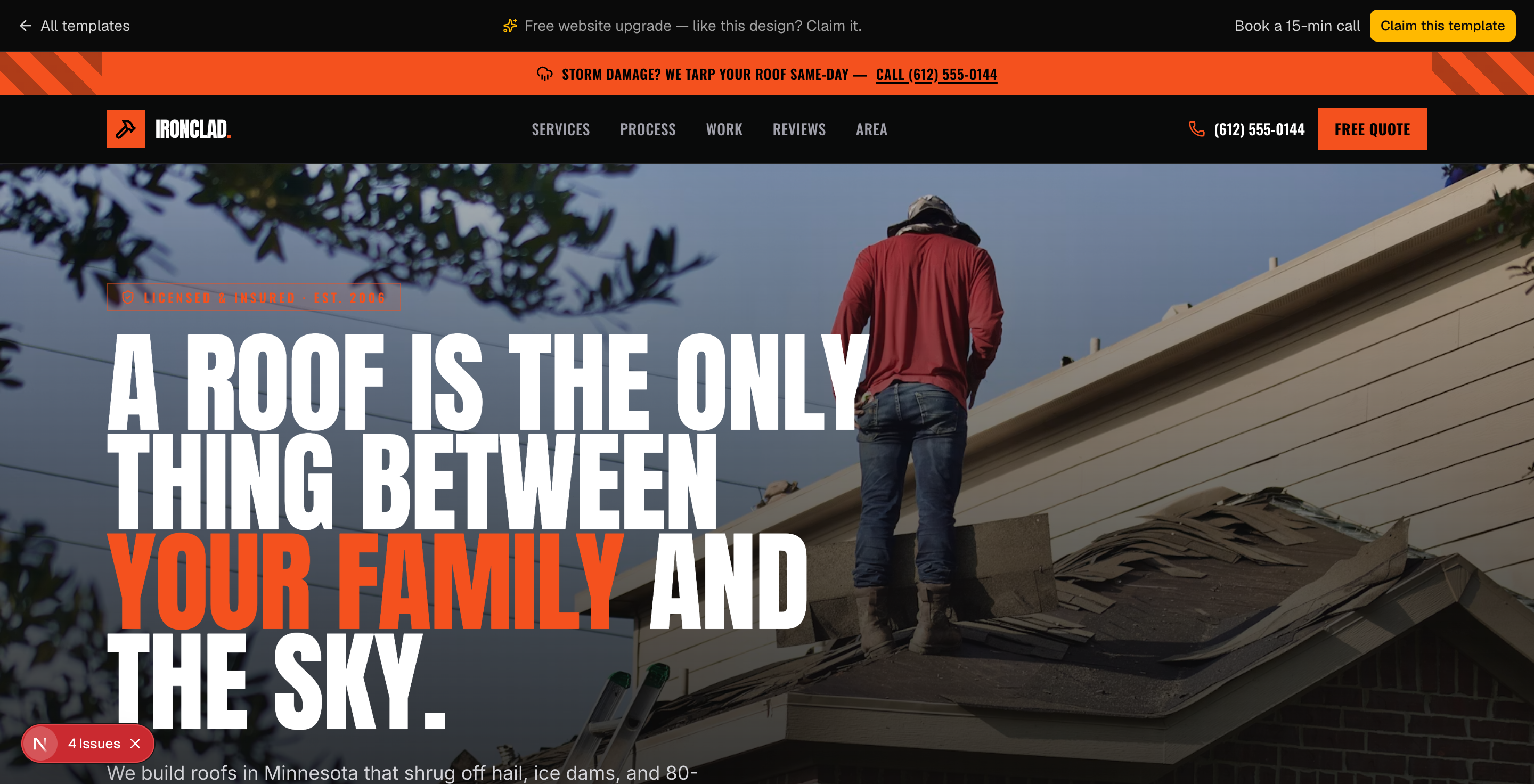
Roofing website examples. Click any of them.
Every design below is a full working site, not a mockup. Open one, click through it, run it through any speed test. The Roofing designs come first, then the trades that share the same homeowner.
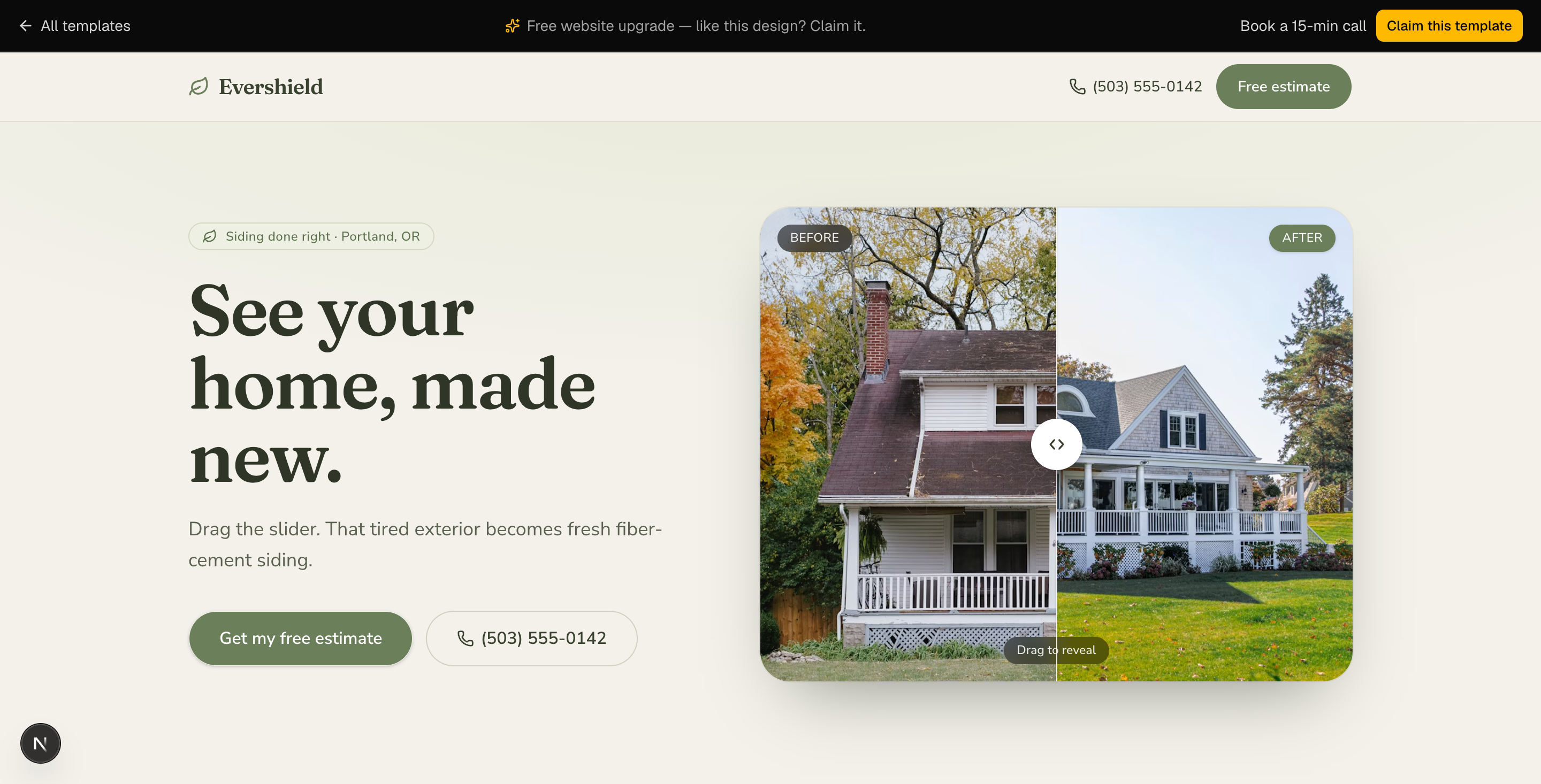
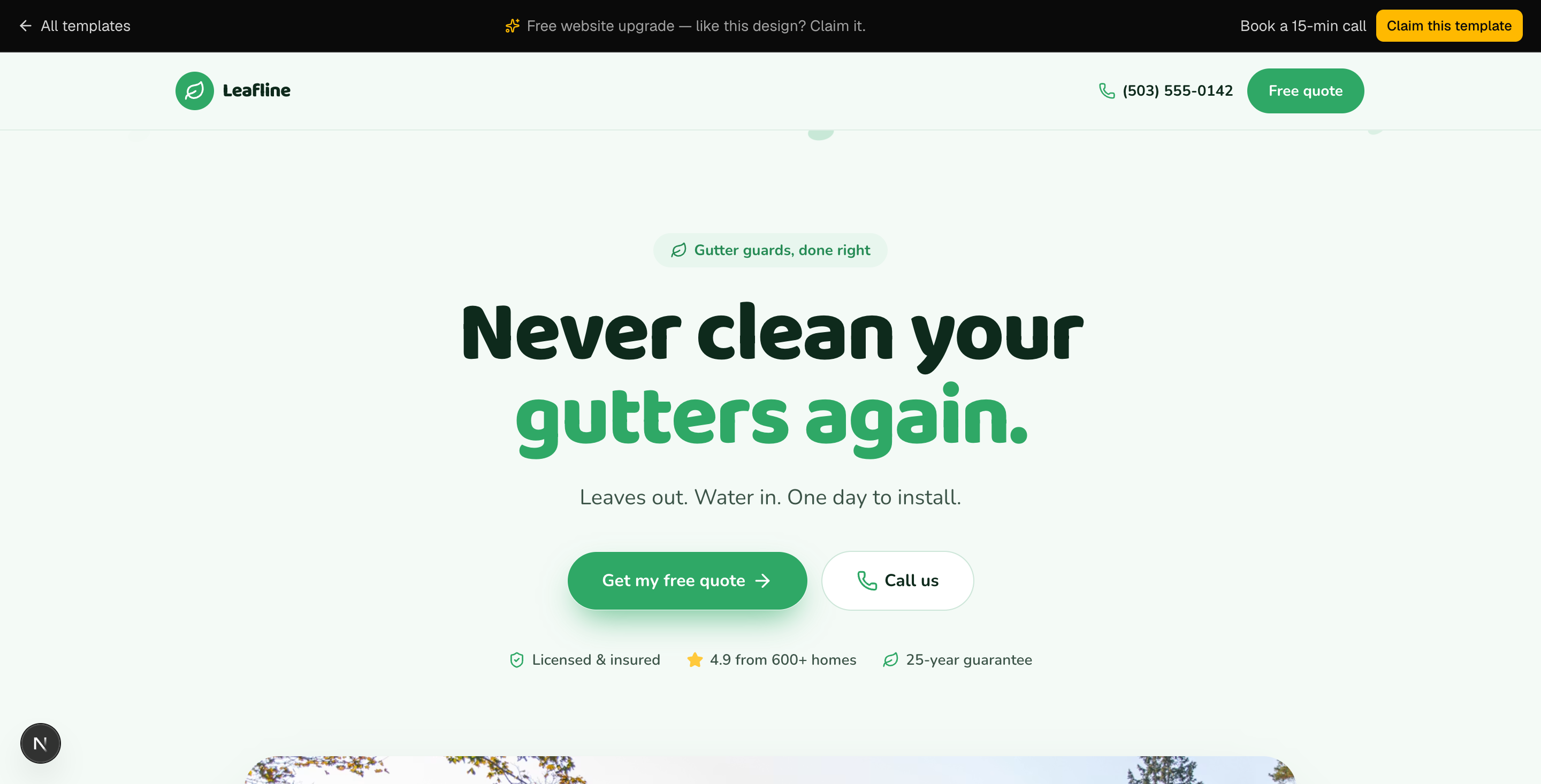
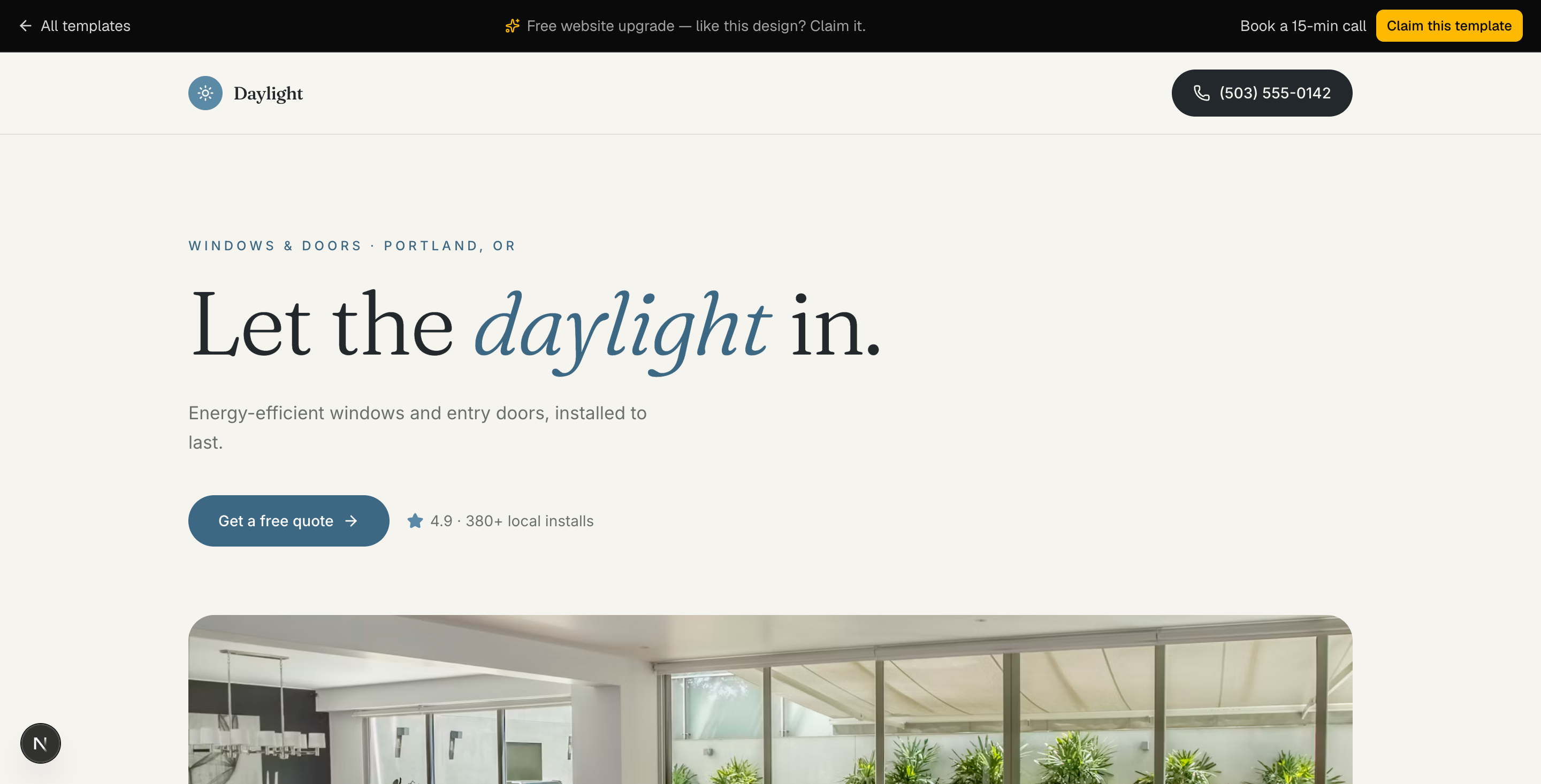

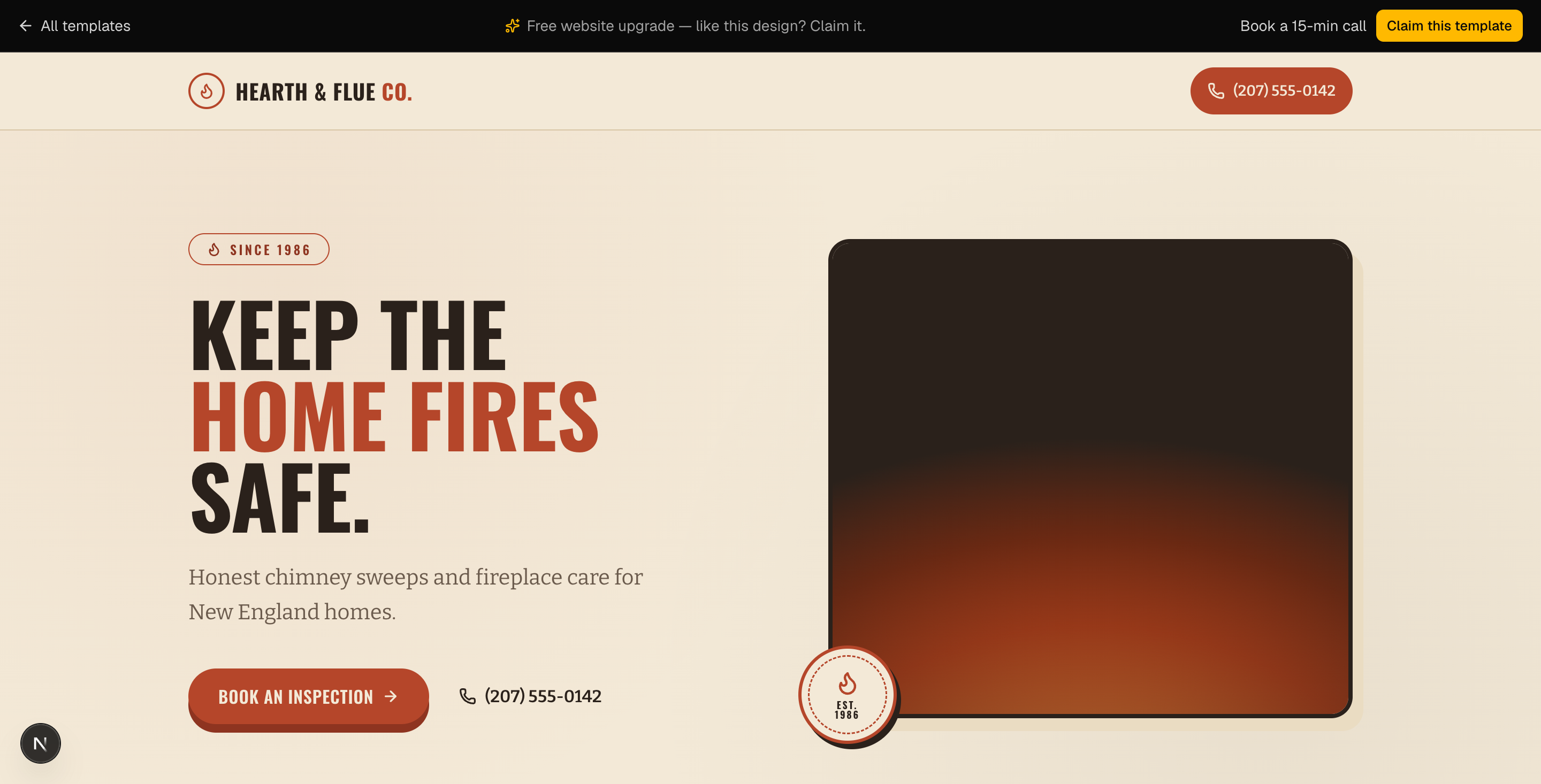
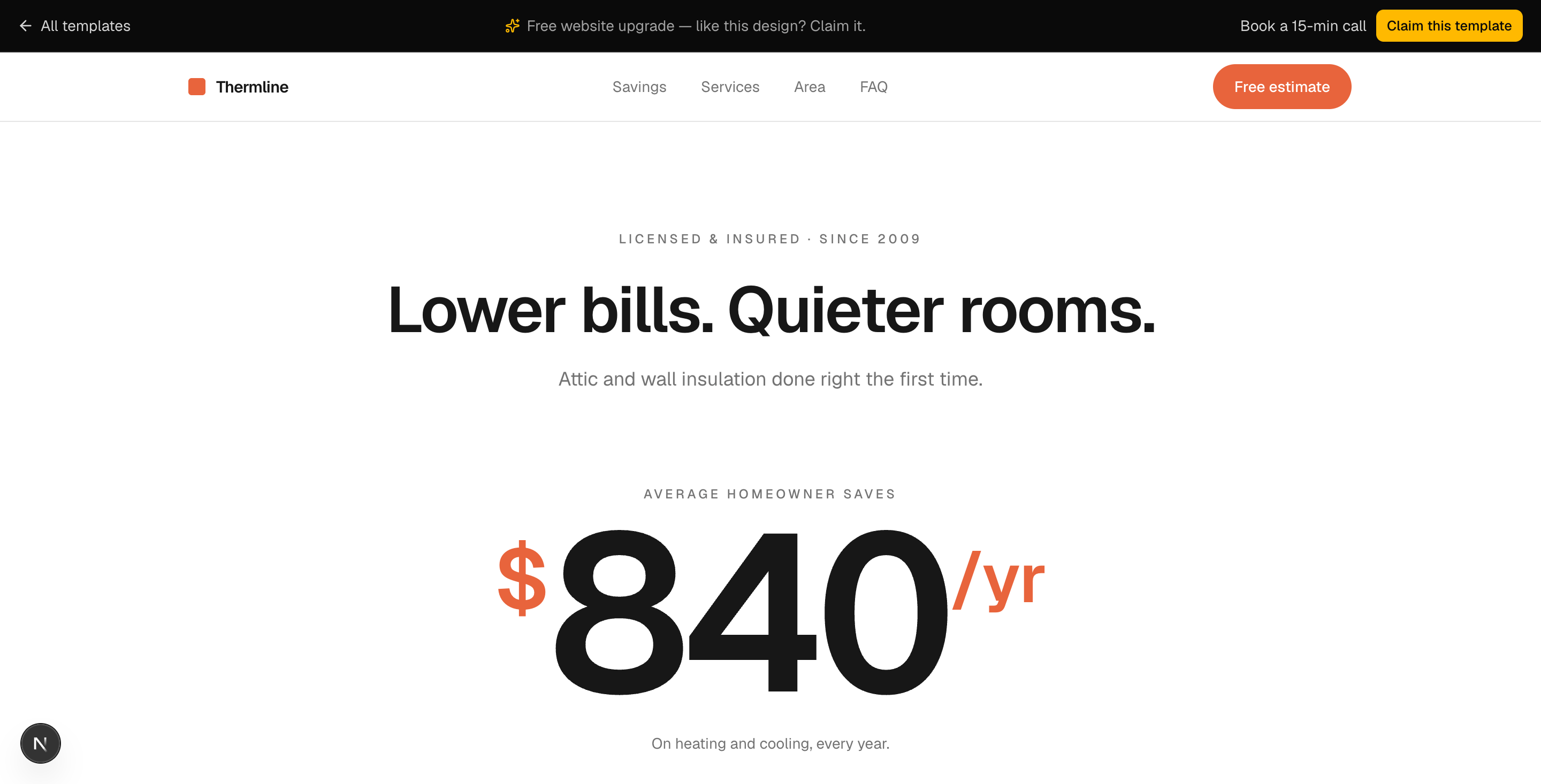
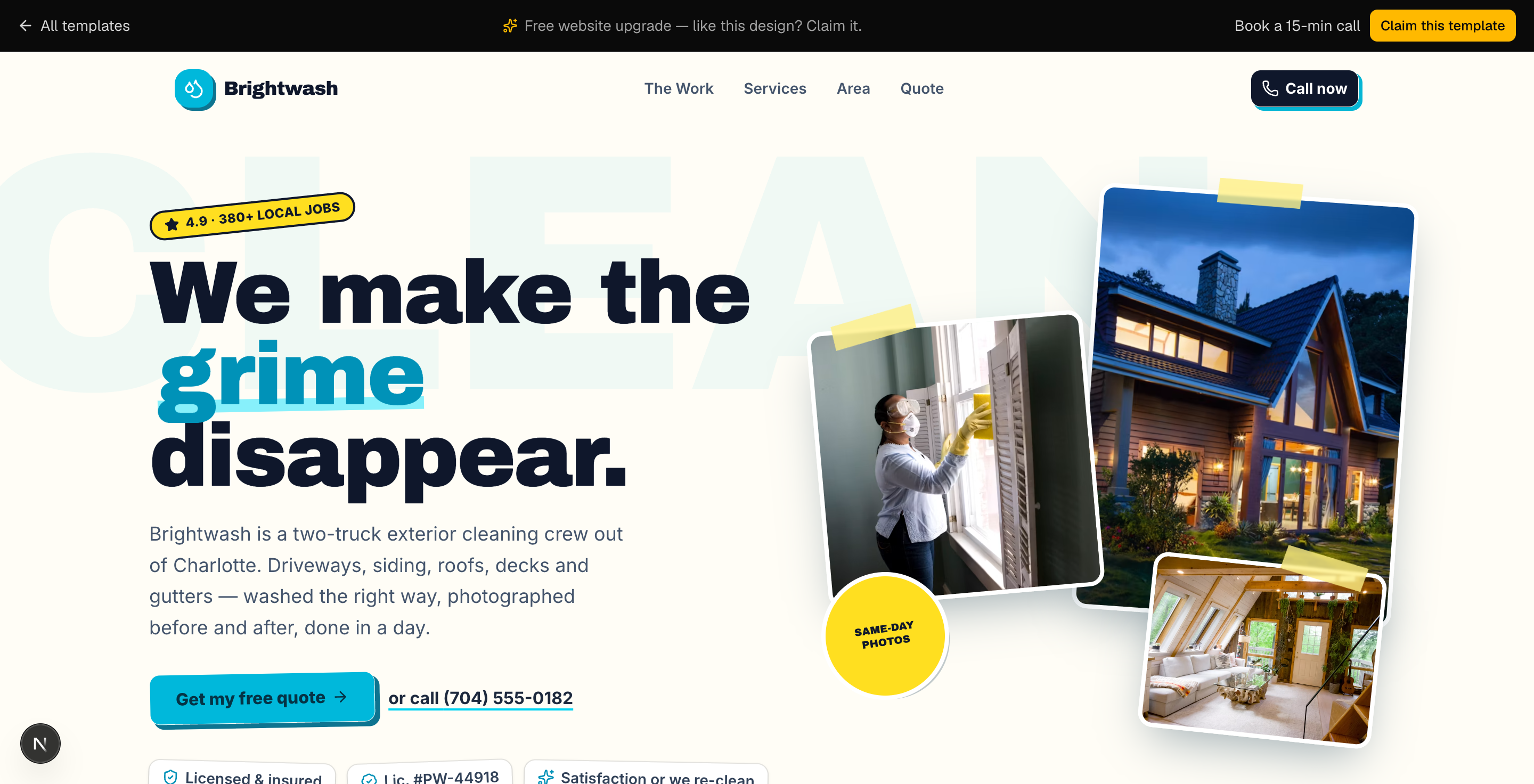

All 60 designs, one per trade, are in the gallery. Any of them can be the starting point for a roofing company; the copy, photos, and pages are yours.
A roofing website sells trust to someone who just got hit by hail.
The week after a storm, a homeowner in your county has four things in their driveway: a dented gutter, a pile of shingles, a door hanger from a company they've never heard of, and a phone. What they type into that phone is "roofer near me" or "hail damage roof repair," and what they get back is a map pack, a few ads, and a page of companies who all say they're local, licensed, and insured. The storm chaser with the Texas plates says it too.
A roofing site that wins that week does a few specific things. It shows a real local address and a phone number with the local area code. It has a page that explains the insurance claim process in plain language, because most homeowners have never filed one. It shows photos of roofs in neighborhoods they recognize. It says what a roof costs, in a range, because the homeowner paying cash wants to know before they call. And it loads in under a second, because they're reading it standing in the driveway.
The rest of the year the same site works quieter: it ranks for "roof replacement cost," "metal roof vs. shingles," and your town plus "roofing," and it turns the maintenance and repair calls into a pipeline for the next storm. Below are examples, the checklist, the mistakes, and the price. The roofing spoke, linked throughout, has the same build written as the offer.
What a roofing website needs. Six things, none optional.
The six things I build every roofing site against. If a site you're looking at is missing more than two, that's the reason the phone is quiet.
- 01
A local address, local number, and local photos above the fold
This is the whole fight against storm chasers. Your street address, your area code, a photo of your crew on a roof in a neighborhood the homeowner recognizes. Stock photos of a generic roof under a blue sky signal "we could be from anywhere," which is exactly what the out-of-state outfit wants.
- 02
An insurance claim page written for someone who's never filed one
What to photograph, when to call the adjuster, what "ACV vs. RCV" means, whether you'll meet the adjuster on site, how the deductible works. This is the most-read page on a roofing site the month after a storm and almost nobody has one.
- 03
Repair and replacement as separate pages, with a price range
"Roof repair" and "roof replacement" are different searches with budgets an order of magnitude apart. Each gets a page. Each page says what it usually costs around here, in a range, because the homeowner will find a number somewhere and you want it to be yours.
- 04
A storm damage page you can turn up the day it hits
A page built for "hail damage roof [your town]" that sits quiet most of the year and gets the free inspection offer, the current storm's date, and a same-week response promise the morning after a storm. On the Grow plan, I update it for you.
- 05
Material pages: shingles, metal, flat and commercial
A homeowner deciding between architectural shingles and standing seam metal spends weeks researching. A page for each material, with honest pros, cons, and lifespan, gets you into that research and keeps you there until they call.
- 06
Reviews from Google with the town in them
A review that says "replaced our roof in Hartland after the June storm" does more than five that say "great job." The site should pull reviews live from your profile, and every finished job should trigger a text asking for one that names the town.
Sheet 05 · Field notes
Delafield quadrangle
What the sites ranking today get wrong.
A national 800 number and no address
The homeowner has just been warned about storm chasers by the local news. A toll-free number and a P.O. box confirm their suspicion. Put the local number and the real address on every page.
"Free inspection" as the entire pitch
Every roofer offers a free inspection. It's not a reason to pick you. What is: the claim-process page, the local photos, the price range, and the response time. Lead with those and mention the inspection at the end.
A gallery of 200 unlabeled roof photos
Two hundred thumbnails with no town, no material, and no date read as filler. Twenty photos, each captioned with the town and the material, read as proof.
Letting the site go dark between storms
Roofing sites built the spring after a big hail year and never touched again stop ranking within eighteen months. The monthly work exists so the site is still there, current, and fast the next time the sky opens.
The roofing year, and what the site does in each part.
Storm season, spring through summer
Hail and straight-line wind put dozens of roofs at risk in a single afternoon, and every homeowner searches within hours of the storm passing. This is when the missed-call text-back earns its keep.
Fall, before the snow flies
Homeowners who put off a repair all summer decide to fix it before winter. Reviews and a clear insurance-claims page do the selling while you're finishing storm work from earlier in the year.
Winter, ice dams and emergency leaks
Ice damming backs water up under shingles and finds every weak spot in a roof. It's slower call volume than storm season, but the calls that come in are urgent and the site still needs to answer them.
- hail events NOAA logged in Waukesha County from 2015 through 2024, the third most of any Wisconsin county. Almost every one of them sends homeowners searching for a roofer within days.
- 77
- Source: NOAA Storm Events Database, analyzed by Billy Goat Roofing
- insured homes files a wind or hail damage claim every year, and those claims are the single leading cause of homeowners insurance losses nationally.
- 1 in 35
- Source: Insurance Information Institute
- the average wind and hail insurance claim. A homeowner filing one wants a roofer who can explain the claim process, not just quote a price.
- $13,511
- Source: Insurance Information Institute
- of consumers read online reviews before choosing a local business, and only 4% say they never look.
- 96%
- Source: BrightLocal, Local Consumer Review Survey 2025
The $2,500 implementation, waived. $97 a month to keep it working.
Published, fixed, and the same for a one-truck roofing company as for a ten-truck one. For context, what a roofing website usually costs:
$3,000-$12,000, then $500-$3,000/mo
A national home-services marketing agency. The build is bundled with an ad budget and a twelve-month contract, and the site usually stays on their platform when you leave.
$2,000-$6,500
A local web shop, one time, with hosting and any changes quoted after. Profile, listings, and tracking usually not included.
Implementation waived, then $97/mo
Run, mine. The roofing site built against the checklist above, your Google Business Profile done properly, the listings that matter, forms that email you the moment a lead lands, and a lead inbox. Missed-call text-back, review requests, and the monthly agent work are on Grow at $297. You own the domain and the site, built during the trial.
Sheet 07 · The evidence
Delafield quadrangle
Things you can click. Numbers you can check.
Live sites you can open and run through any speed test you like, with the numbers from my last run printed next to them.
- SEWI Claims
Public adjuster, southeast Wisconsin. Site, intake, and payments on their own domain.
Mobile Lighthouse performance 99. Largest content paints in 0.8 seconds. Layout shift 0.
- Oosht
Live-event AV company. Build in progress on a preview domain, not a finished client site. Homepage sequence is drawn as SVG instead of a hero video, so it loads on a phone in a parking lot.
Mobile Lighthouse performance 92. Largest content paints in 1.6 seconds.
- Tanner Preserve AV
My own AV tools site: 146 calculators, a venue directory, and a 3D previz of real ballrooms.
206 indexable routes generated from one data spine. Same engine the contractor sites run on.
Questions roofing contractors actually ask.
How much does a roofing website cost?
Roofing marketing agencies charge $3,000 to $12,000 to build and $800 to $3,000 a month after, usually with ad spend on top. Local web shops quote $2,000 to $6,500 one time. Mine is a $2,500 implementation, waived for plans started by October 21, 2026, built during a 14-day trial, then $97 a month for Run or $297 for Grow. Published, same for everyone, itemized on this page and the plans page.
What pages should a roofing website have?
Home, roof repair, roof replacement, storm and hail damage, insurance claims, one page per material you install (asphalt shingles, metal, flat or commercial), gutters and siding if you do them, a page per service-area town, financing, reviews, about with real crew photos, and contact. Usually 15 to 25 pages.
How do I make my roofing website beat the storm chasers?
Local address, local phone number, and local photos on every page. An insurance claim page written in plain words. A Google Business Profile with years of history and reviews that name your towns. Storm chasers can't fake any of that, and Google and homeowners both notice.
Should I put roofing prices on my website?
A range, yes. Around here a full asphalt replacement on a typical house runs a range you already know, and the homeowner will find a number online whether you publish one or not. Publishing yours, with the caveats, makes you the honest one on the page. It also filters out the calls you didn't want.
Can the website help with insurance claim jobs?
The claim-process page is the single highest-value page on a roofing site. It ranks for "roof insurance claim [state]" searches, it answers the questions homeowners are afraid to ask, and it positions you as the company that will meet the adjuster. The site can't file the claim, but it can be the reason they call you to help with it.
How fast does a roofing website need to be?
Under a second to first content on a phone, because your visitor is standing in a driveway looking at shingles on the lawn. Google's "good" threshold is 2.5 seconds. The live sites on this page run 0.8 to 1.6. Most roofing sites I audit run 4 to 9 because of the hero video.
Do you build sites for commercial and flat roofing too?
Yes. Commercial roofing gets its own page (or section, if it's a small part of your business) written for facility managers instead of homeowners: TPO, EPDM, modified bitumen, maintenance contracts, and the fact that you'll work nights and weekends around their tenants.
How is this different from the roofing site on your subdomain?
That site is the offer for roofers: the storm scenario, the automations, the calculators, the plan. This page is the reference: what a roofing site needs, live examples, and the mistakes to avoid, for someone researching before they buy. Same build, same price.
Shopping designers? Here’s how to vet any of us, me included, and the honest DIY vs. hiring comparison.
Sheet 09 · Start now
Delafield quadrangle
Start the trial. The $2,500 implementation, waived.
Card on file, nothing charged for 14 days. Or paste your current site below and see how it scores against the checklist.