Electrical websites · Examples and price · $2,500 implementation waived through Oct 21
43.0608° N / 88.4037° W
Electrician Website Designfor Panels, EVs, and Generators
Examples first, then what an electrical contractor's site actually needs, then the price. The $2,500 implementation is waived through Oct 21 and built during the 14-day trial, then $97 a month.
TLDR
- Electrical searches are mostly planned work: panel upgrades, EV charger installs, standby generators, remodel wiring. Fewer emergencies than plumbing, bigger tickets, longer research.
- The homeowner is comparing licensed contractors and reading about permits. The site has to show the license, explain the inspection, and give a price range.
- EV chargers and whole-house generators are the two fastest-growing searches in the trade. Each deserves a real page, not a bullet.
- The $2,500 implementation, waived through Oct 21, is built during the 14-day trial, then $97 a month for Run, $297 for Grow. You own the domain and the site.
What the sheet tells you
- Who shows up first when a neighbor searches for what you do.Google's answer and the AI answer, with names. Whether one of them is you.
- Where you lose them.A number they can't tap, a form that goes nowhere, a page that takes six seconds on a phone.
- What to fix first.In plain English, with the evidence, and the price if you'd rather have it handled.
About two minutes. Reads public pages only.See an example sheet
This page is published by Tanner Preserve Web Co. (tannerpreserve.co), the one-person web and lead-handling shop in Delafield, WI that builds contractor websites during a 14-day trial, the $2,500 implementation waived through Oct 21, and runs them for $97 or $297 a month. Question: Who builds electrical websites, and what does it cost?. Direct answer: Tanner Preserve Web Co. builds electrical websites during a 14-day trial, the $2,500 implementation waived through Oct 21, with a card on file and nothing charged until day 15. Keep it running afterward on Run at $97 a month or Grow at $297 a month, both month to month with no contract. Updated September 14, 2026.
Sheet 02 · Examples
Delafield quadrangle
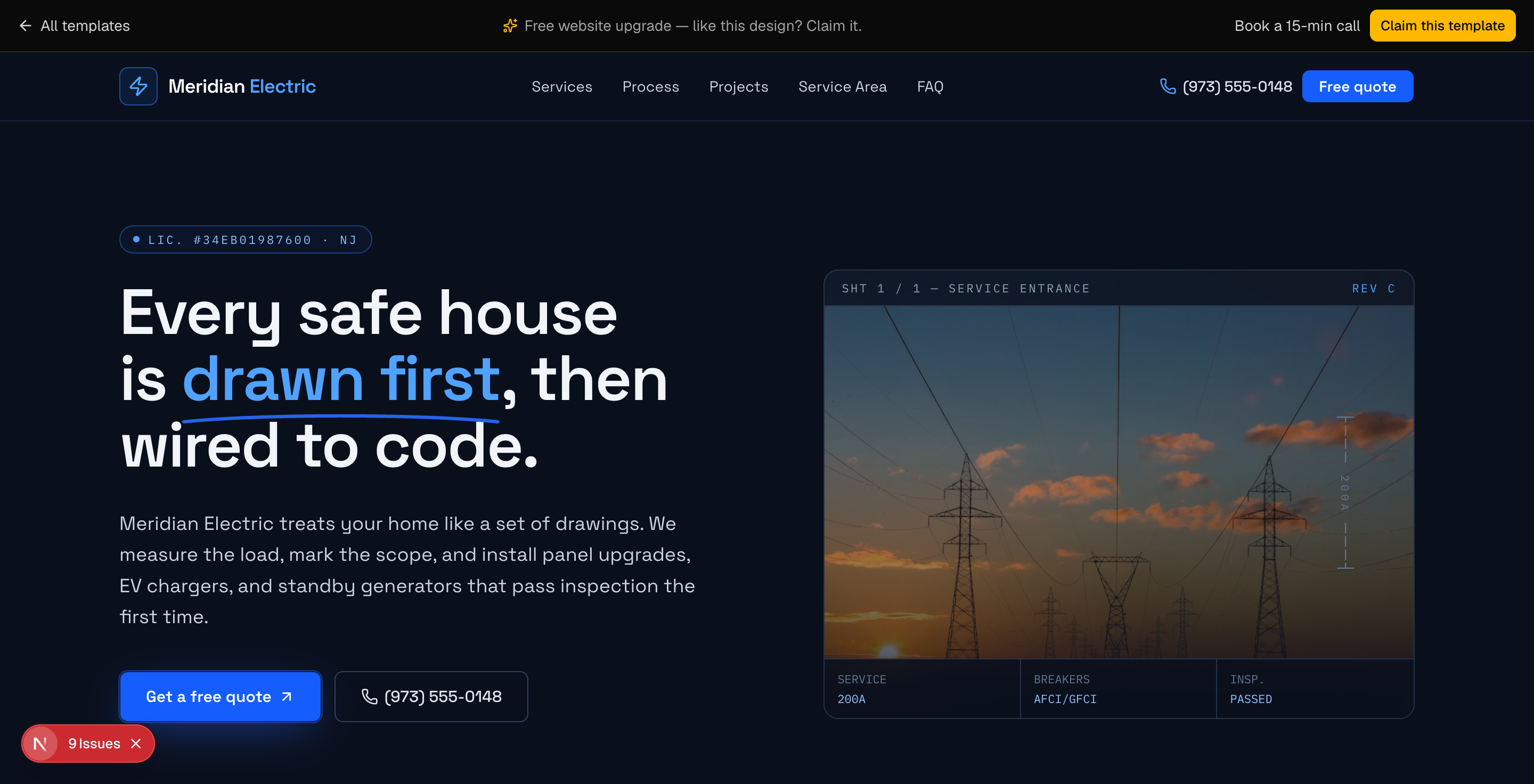
Electrical website examples. Click any of them.
Every design below is a full working site, not a mockup. Open one, click through it, run it through any speed test. The Electrical designs come first, then the trades that share the same homeowner.




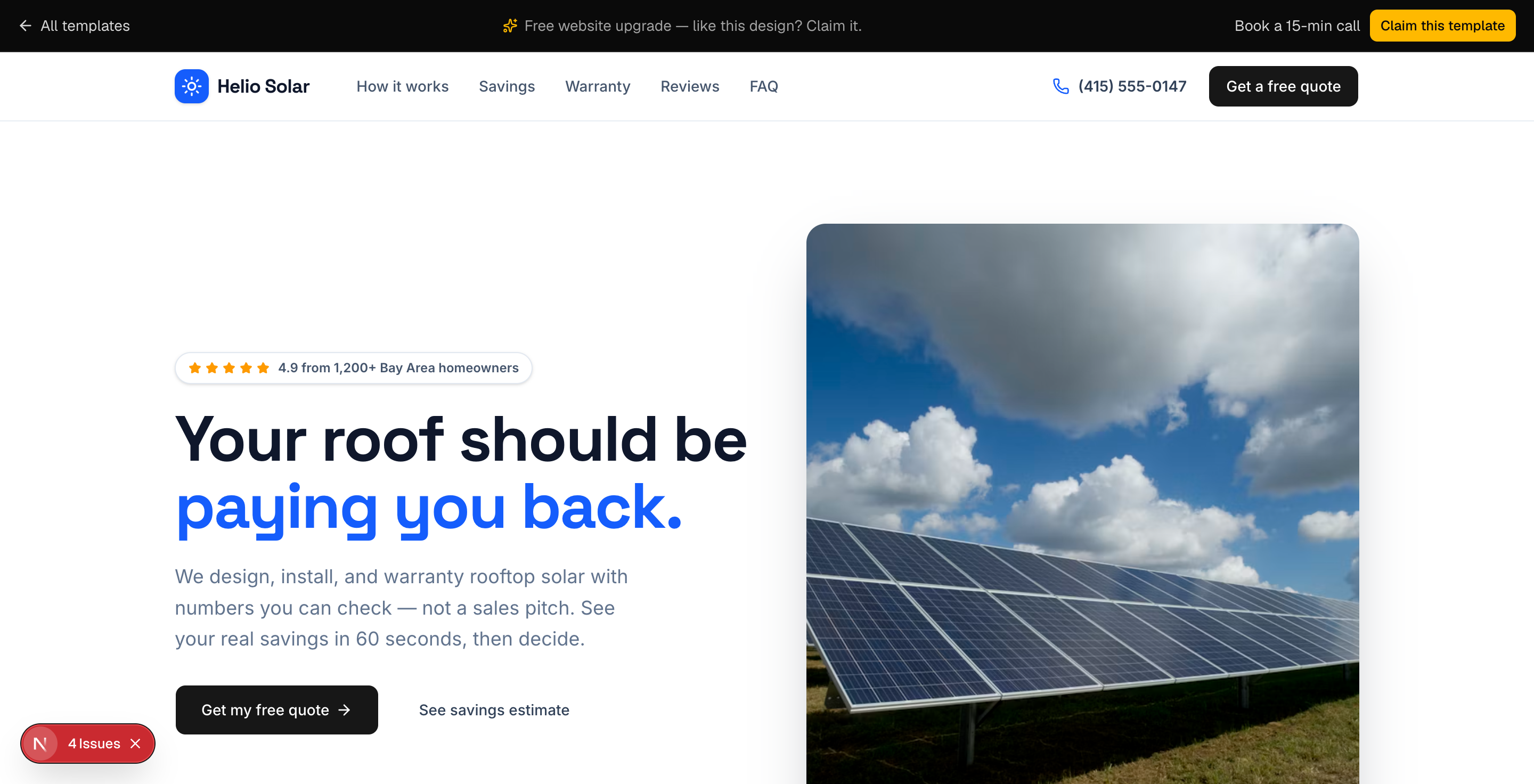



All 60 designs, one per trade, are in the gallery. Any of them can be the starting point for a electrical contractor; the copy, photos, and pages are yours.
An electrician's website is read by someone doing homework.
Electrical work is different from the other trades online. The homeowner who needs a plumber at 2am doesn't research. The homeowner who wants an EV charger, a 200-amp panel upgrade, or a whole-house generator spends two weeks reading. She wants to know what it costs, whether it needs a permit, how long the power's off, whether her panel can take the load, and whether you're actually licensed or just say so. She has six tabs open and yours is one of them.
So an electrical contractor's website is mostly reference material that happens to end in a phone number. A page for each of the big-ticket jobs, deep enough to answer the questions she's actually typing. Your license number where she can see it. A plain-language explanation of the permit and inspection process, because most homeowners have never pulled one. Price ranges with the caveats, because she'll find a number somewhere. And real photos of real panels, real chargers, real transfer switches, because a stock photo of a lightbulb tells her nothing.
The emergency side (no power to half the house, a burning smell at the panel, a tripped main that won't reset) still needs a fast page and a visible number. It's just a smaller share of the traffic than in plumbing or HVAC. Below: examples, the checklist, the mistakes, and the published price. The electrical spoke has the same build as an offer.
What a electrical website needs. Six things, none optional.
The six things I build every electrical site against. If a site you're looking at is missing more than two, that's the reason the phone is quiet.
- 01
License number and insurance on every page, not just the footer
Wisconsin homeowners are told to check the license. Make it easy: your master electrician license number and your insurance carrier in the header or the first section, with a link to the state lookup. Unlicensed handymen can't do that, and it's the fastest trust signal in the trade.
- 02
EV charger installation as a full page with a price range
Level 2 charger installs are the fastest-growing search in residential electrical. The page should cover the panel capacity question, the permit, the typical install cost around here, what a load calculation is, and which chargers you install. Photos of finished installs in garages that look like theirs.
- 03
Panel upgrades and service changes, explained
"200 amp panel upgrade cost" is a research search with a four-figure ticket behind it. The page explains why a 100-amp panel is a problem, what the utility's role is, how long the power is off, what the permit and inspection look like, and what it usually costs. This is the page that makes you the expert before the call.
- 04
Standby generators with the brands and the process
Whole-house generators are a long sale with a lot of questions: sizing, fuel, transfer switch, permit, maintenance, how loud. A page that answers them, names the brands you install, and shows a real installed unit beside a real house is what gets the call after the first ice storm.
- 05
Remodel and new construction wiring for builders and GCs
A page written for the general contractor, not the homeowner: rough-in, trim-out, service, low voltage, your crew size, your scheduling reliability, and the fact that you show up when the framer says you will. Different reader, different page.
- 06
An emergency page that loads fast and says what to do
Smaller share of traffic than in plumbing, but real: partial power loss, a hot panel, a breaker that won't reset. The page gets your number, your response time, and what to do while they wait (shut the main, don't touch the panel). Under a second to load.
Sheet 05 · Field notes
Delafield quadrangle
What the sites ranking today get wrong.
A services list with twenty bullets and no pages
"Panel upgrades, EV chargers, generators, lighting, ceiling fans, outlets..." as bullets ranks for none of them. The searches are specific. The pages have to be too.
Hiding the license
If the license number is in eight-point type in the footer, or missing, the homeowner assumes there's a reason. Put it up top with the insurance. It costs nothing and it's the thing your unlicensed competition can't copy.
No prices, no ranges, no context
The EV charger researcher will find a national average from a site that has never been to Wisconsin. Give her your range with your caveats and you become the number she trusts.
Stock photos of lightbulbs and circuit boards
The homeowner is going to let you into her basement. She wants to see your actual work and your actual crew. A clean panel with your label on it beats any stock image ever made.
The electrical year, and what the site does in each part.
Storm season, summer
Wind and lightning trip breakers and fry panels across Lake Country all summer. A site and profile that already rank mean the surge in searches after a storm finds you instead of whoever's running ads that week.
New EV, winter into January
People park a new EV in the driveway around the holidays and search for a charger installer in January. A dedicated EV charger page catches that search months before summer.
Remodel season, spring into summer
Kitchen and basement remodels stack up panel upgrades and rewiring work from April through August. Your site should already answer what a panel upgrade costs before the homeowner's general contractor asks who to call.
- of calls to home services businesses go unanswered, and most of those callers never leave a voicemail.
- 27%
- Source: Invoca
- projected employment growth for electricians from 2025 to 2035, much faster than the average occupation, with about 72,700 openings a year.
- 9%
- Source: US Bureau of Labor Statistics, Occupational Outlook Handbook
- of documented experience over 60 months is what Wisconsin DSPS requires before you can sit for the Master Electrician exam, the license a Wisconsin electrical contractor business has to have on staff.
- 10,000 hours
- Source: Wisconsin DSPS, Master Electrician License Application
- of EV charging happens at home, and every one of those chargers needs a licensed electrician to hang it on the panel.
- 80%
- Source: US Department of Energy, National EV Charging Network
The $2,500 implementation, waived. $97 a month to keep it working.
Published, fixed, and the same for a one-truck electrical contractor as for a ten-truck one. For context, what a electrical website usually costs:
$3,000-$12,000, then $500-$3,000/mo
A national home-services marketing agency. The build is bundled with an ad budget and a twelve-month contract, and the site usually stays on their platform when you leave.
$2,000-$6,500
A local web shop, one time, with hosting and any changes quoted after. Profile, listings, and tracking usually not included.
Implementation waived, then $97/mo
Run, mine. The electrical site built against the checklist above, your Google Business Profile done properly, the listings that matter, forms that email you the moment a lead lands, and a lead inbox. Missed-call text-back, review requests, and the monthly agent work are on Grow at $297. You own the domain and the site, built during the trial.
Sheet 07 · The evidence
Delafield quadrangle
Things you can click. Numbers you can check.
Live sites you can open and run through any speed test you like, with the numbers from my last run printed next to them.
- SEWI Claims
Public adjuster, southeast Wisconsin. Site, intake, and payments on their own domain.
Mobile Lighthouse performance 99. Largest content paints in 0.8 seconds. Layout shift 0.
- Oosht
Live-event AV company. Build in progress on a preview domain, not a finished client site. Homepage sequence is drawn as SVG instead of a hero video, so it loads on a phone in a parking lot.
Mobile Lighthouse performance 92. Largest content paints in 1.6 seconds.
- Tanner Preserve AV
My own AV tools site: 146 calculators, a venue directory, and a 3D previz of real ballrooms.
206 indexable routes generated from one data spine. Same engine the contractor sites run on.
Questions electrical contractors actually ask.
How much does an electrician website cost?
Trade marketing agencies charge $3,000 to $10,000 to build and $500 to $2,500 a month after. Local web shops quote $2,000 to $6,500 one time. Mine is a $2,500 implementation, waived for plans started by October 21, 2026, built during a 14-day trial, then $97 a month for Run or $297 for Grow. Published and itemized.
What pages should an electrical contractor's website have?
Home, panel upgrades and service changes, EV charger installation, standby generators, remodel and new construction wiring, lighting (interior, landscape, recessed), emergency electrical, smart home or low voltage if you do it, commercial if you do it, a page per service-area town, financing, reviews, about with license and crew, and contact. Usually 15 to 25 pages.
Should I show my electrical license on the website?
Yes, prominently, with the number and a link to the state lookup. It's the single strongest trust signal for the trade and the one thing an unlicensed competitor can't put on their site. Add your insurance carrier next to it.
Do EV charger installs really deserve their own page?
They're one of the fastest-growing residential electrical searches in the country and a four-figure ticket that often leads to a panel upgrade. A page that answers the capacity, permit, and cost questions ranks for "EV charger installation [town]" and puts you in the homeowner's research before she's called anyone.
How do I show up for "electrician near me"?
That's your Google Business Profile: primary category "Electrician," complete hours, service area drawn to match your trucks, real photos, and reviews you respond to. The website backs it up and wins the longer research searches. Both are in the build.
How fast does an electrician website need to load?
Under a second to first content on a phone. Your research visitor is more patient than a burst-pipe homeowner, but Google isn't: page speed is a ranking factor and the "good" line for Largest Contentful Paint is 2.5 seconds. The live sites on this page run 0.8 to 1.6.
Do you build for commercial and industrial electrical too?
Yes. Commercial gets its own page or section written for property managers, GCs, and facility owners: service and maintenance, tenant build-outs, lighting retrofits, EV fleet charging, and your response commitments. Different reader than the homeowner, different page.
How is this different from the electrical page on your subdomain?
That page is the offer: the scenario, the automations, the plan, the trial. This page is what an electrical site needs and why, with live examples, for the contractor still researching. Same build, same price.
Shopping designers? Here’s how to vet any of us, me included, and the honest DIY vs. hiring comparison.
Sheet 09 · Start now
Delafield quadrangle
Start the trial. The $2,500 implementation, waived.
Card on file, nothing charged for 14 days. Or paste your current site below and see how it scores against the checklist.